Soft Cover, English, Thread Stitching, 120 Pages, 2019
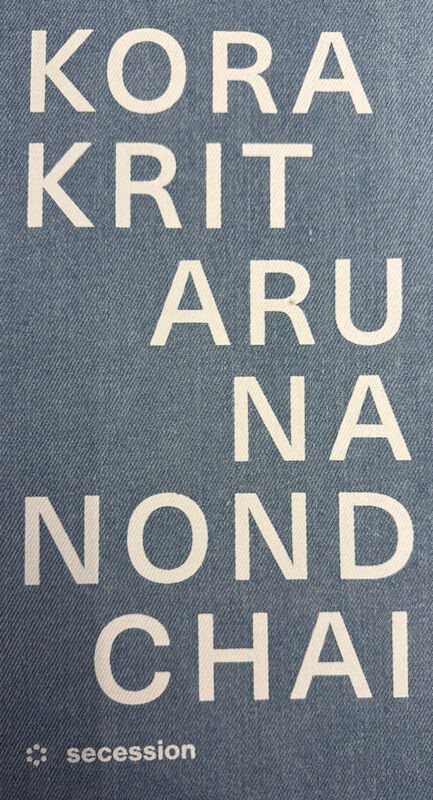
Korakrit Arunanondchai
Korakrit Arunanondchai’s publication operates as an extension of his practice, in which painting, moving image, performance, and installation are conceived as interdependent narrative systems.
Rather than functioning as a conventional exhibition catalogue, the book stages a discursive field in which images, scripts, fragments of correspondence, and documentation intersect. The publication thus reflects the artist’s central concern: how subjectivity is constructed within overlapping regimes of memory, technology, and spirituality.
Arunanondchai’s work frequently engages with the circulation of images in a post-digital condition. Denim paintings, video works, and performative gestures are not treated as discrete media, but as transitional states within a broader ecology of transmission. Fire, myth, personal narrative, and global media flows coexist within his visual language. The book mirrors this structure. It does not impose linear interpretation; instead, it proposes a layered sequencing that allows meaning to emerge through juxtaposition and recurrence.
A recurring motif in Arunanondchai’s practice is the oscillation between intimacy and spectacle. Personal histories—often articulated through fictionalized alter egos—are embedded within larger geopolitical and ecological contexts. The publication underscores this strategy by combining documentary material with speculative narration. The reader encounters the work not as static documentation, but as an active process of translation between body, image, and environment.
Materially, the book reinforces the conceptual framework of the work. Typography, image scale, and pacing function as structural devices rather than neutral design decisions. Pages operate as temporal intervals, comparable to edits in film. The publication therefore becomes a time-based medium in print form—an archive that remains performative.
In this sense, the book does not conclude the project it accompanies. It extends it. It situates Arunanondchai’s practice within broader conversations on postcolonial identity, animism, digital consciousness, and the politics of visibility, while maintaining the instability that defines his artistic method.
If you provide the exact title and ISBN of the book in question, I can prepare a precise bibliographic entry and a more specific text aligned to that publication.