Onyeka Igwe
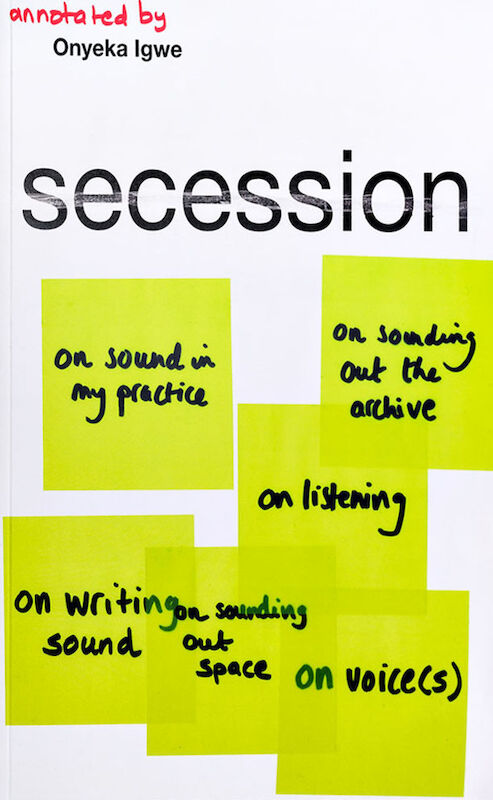
Published in conjunction with the exhibition at the Secession in 2026, this publication explores central concerns of Onyeka Igwe’s artistic practice within the medium of the book.
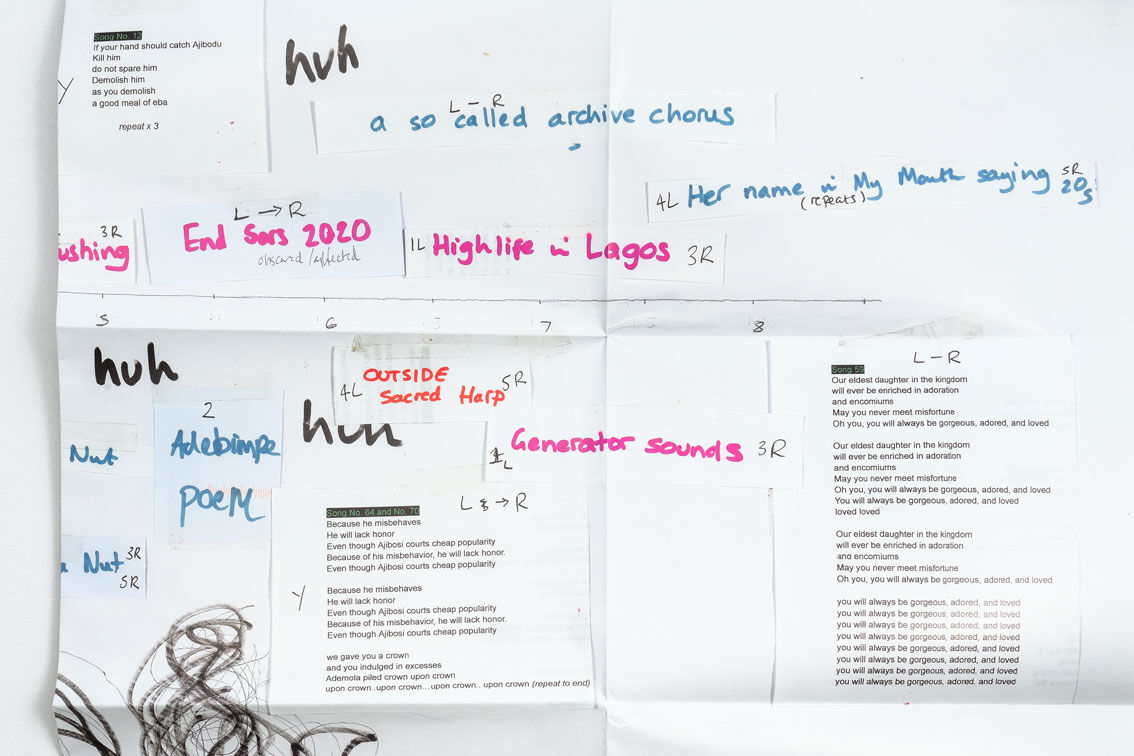
It focuses on processes of montage, rereading, and editorial displacement, through which archival material, theoretical texts, conversation, and sound are brought into a nonlinear structure.
The publication brings together texts by Katherine McKittrick and Alexander Ghedi Weheliye, as well as a conversation initiated by Igwe between Samra Mayanja, Shenece Oretha, and Richy Carey about their work with sound. The artist did not merely compile the contributions editorially, but physically reworked them: they were printed, cut up, and reassembled. In this way, a textual score emerges, allowing reading to be experienced as a rhythmic, temporal, and performative process.
This editorial method reflects Igwe’s engagement with history, memory, and the archive. Her work examines how colonial and postcolonial narratives are transmitted, omitted, fragmented, or rearranged. The book is therefore not conceived as a supplementary document to the exhibition, but as a space in its own right, in which theory, voice, sound, and image enter into an open relation.
Onyeka Igwe is an artist, filmmaker, and researcher. Her work explores the relationships between body, voice, memory, archives, and the continuing effects of colonial structures.
Die begleitend zur Ausstellung in der Secession 2026 erscheinende Publikation setzt zentrale Fragestellungen von Onyeka Igwes künstlerischer Praxis im Medium Buch fort. Im Zentrum stehen Verfahren der Montage, der Relektüre und der editorischen Verschiebung, durch die Archivmaterial, theoretische Texte, Gespräch und Klang in eine nicht lineare Struktur überführt werden.
Die Publikation versammelt Texte von Katherine McKittrick und Alexander Ghedi Weheliye sowie ein von Igwe initiiertes Gespräch zwischen Samra Mayanja, Shenece Oretha und Richy Carey über ihre Arbeit mit Klang. Die Künstlerin hat die Beiträge nicht lediglich redaktionell zusammengestellt, sondern physisch bearbeitet: Sie wurden ausgedruckt, zerschnitten und neu montiert. Dadurch entsteht eine textuelle Partitur, die das Lesen als rhythmischen, zeitlichen und performativen Vorgang erfahrbar macht.
Diese editorische Methode verweist auf Igwes Auseinandersetzung mit Geschichte, Erinnerung und Archiv. Ihre Arbeit fragt danach, wie koloniale und postkoloniale Erzählungen überliefert, ausgelassen, fragmentiert oder neu angeordnet werden können. Das Buch wird dabei nicht als ergänzendes Dokument zur Ausstellung verstanden, sondern als eigenständiger Raum, in dem Theorie, Stimme, Klang und Bild in ein offenes Verhältnis treten.
Onyeka Igwe ist Künstlerin, Filmemacherin und Forscherin. Ihre Arbeiten untersuchen die Beziehungen zwischen Körper, Stimme, Erinnerung, Archiv und den Nachwirkungen kolonialer Strukturen.