
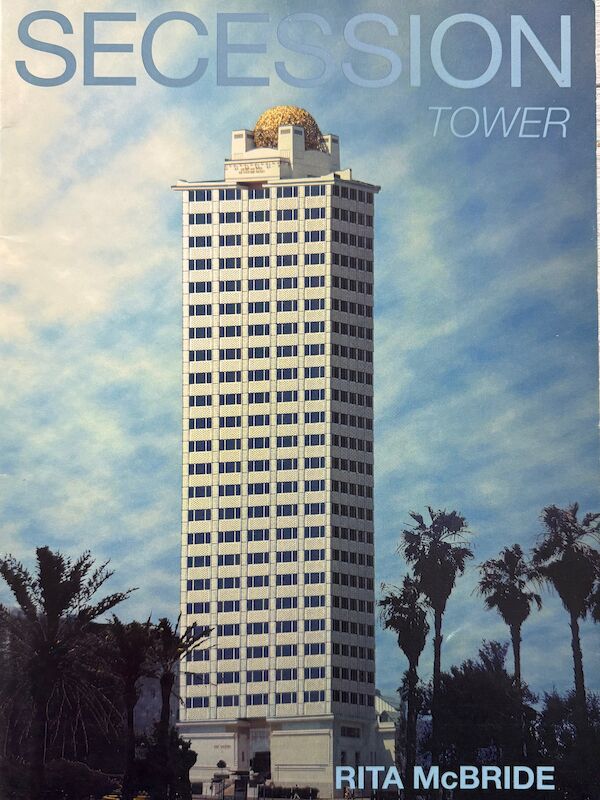
Rita McBride’s - Secession Tower
Rare Bookavailability unknown, if interested please write an email
Rita McBride’s Secession Tower takes as its point of departure one of the most symbolically charged buildings of Viennese modernism: the Vienna Secession.
Designed by Joseph Maria Olbrich and built in 1897/98, the exhibition building was conceived as an architectural manifesto for a movement committed to artistic renewal. McBride does not approach this historical structure as a document, but transforms it into a speculative model: the Secession appears as a high-rise, a hybrid between a Jugendstil icon and a modernist office tower.
This transformation alters the way the building can be read. What originally emerged in Vienna as a pavilion-like exhibition space with a strong programmatic charge is translated by McBride into the vertical typology of urban power architecture. The distinctive golden dome of the Secession building, historically associated with artistic autonomy and symbolic distinction, becomes an architectural crown, an emblematic addition, almost an interchangeable sign. Ornament and function, history and economy, monument and model enter into a precise tension.
McBride is less interested in architecture as a stable form than in architecture as a carrier of social, cultural, and ideological projections. In Secession Tower, the museum is not presented as a neutral space, but as a system of representation, prestige, and institutional self-assertion. The work asks what happens when a building once associated with artistic separation and aesthetic reform is translated into the language of global administration, corporate verticality, and urban branding.
McBride’s method remains deliberately restrained and analytical. The work does not simply parody modernism; rather, it exposes its continuities: faith in progress, monumentality, seriality, and the fusion of culture with the image of the city. Secession Tower is therefore at once a homage, an architectural fiction, and an institutional critique. It demonstrates that architecture never merely organizes space; it also produces meaning.