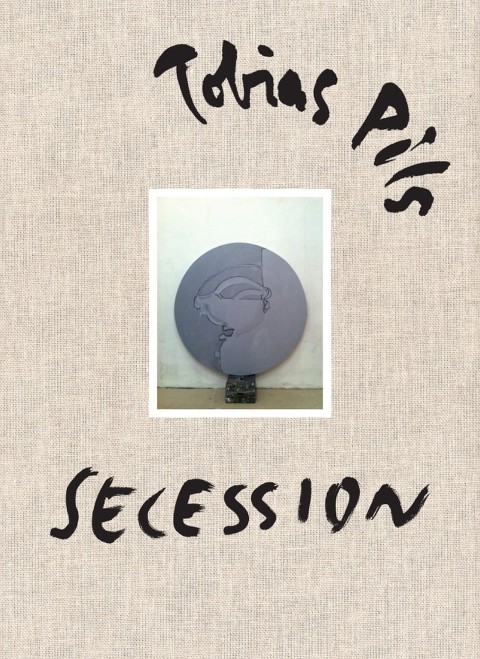
Tobias Pils presents a new series of works created specifically for the Secession, comprising large-format paintings and a site-specific installation.
Even in the run-up to the exhibition and before the actual painting process began, Pils engaged intensively with the exhibition’s concept. The result is a painting exhibition in which production and presentation are conceived holistically and merge into a single entity. Pils, who works primarily in the media of painting and drawing, has repeatedly realized or conceived projects in or for public spaces—often in collaboration with artist friends, musicians, and writers.
Pils’s working method is characterized by his attempt, at the beginning of a new work, to forget all previous ones and to engage with a single motif. This motif can be “anything at all—a familiar allegory, but also an abstract rhythm or chord.” By analogy and applied to the larger context of the exhibition, Pils has chosen the Secession itself as the leitmotif and source of inspiration for his exhibition in the gallery. Intertwined elements and characteristic forms, such as the motif of the laurel dome—the Secession’s trademark—flowed naturally into his visual language. The simple exhibition title Secession identifies the venue as a reference, yet in its unpretentiousness leaves enough room for distance, irony, and—artistic
Freedom. For in some of his visual or conceptual references, Pils draws on historical allusions related to the Secession and, more broadly, the zeitgeist of the dawning 20th century, without thereby compromising his ongoing exploration of painterly issues. Intuition, inspiration, and individuality are criteria relevant to Pils’s painterly oeuvre and underpin his understanding of painting as a language and a means of expression.
Pils works in large formats, which, with their specific demands on the artist’s physicality, make not only his characteristic visual language but also the physicality of painting itself a constitutive factor of the image. The visual language Pils has developed in recent years combines expressive elements with geometric structures such as grids and, despite the dominant tendency toward abstraction, never entirely severs the connection to representation—whether through set pieces from “reality” or through references, for example, to the topos of landscape.
“Every element of a work of art must point in at least two directions: first, to its meaning, which manifests itself in its resemblance to nature or as the conceptualization of a theory, and second, to the artist’s psychological or emotional state, which is expressed therein.”
Pils’s exhibition at the Secession seems to break through the gallery’s physical boundaries and spill out beyond them. Shortly after entering the building, visitors encounter an artistic installation in the stairwell, which is lined with handmade tiles painted in wavy blue patterns by the artist and transformed into a “tunnel.” This evokes memories of New York subway stations or even Otto Wagner’s nearby tram stations, which in turn served as models for Joseph Maria Olbrich, the architect of the Secession. The blue-painted tiles with their wave motif evoke a naive, childlike depiction of water, but could just as easily be characters from a foreign, unknown language. Pils’ playful yet ironic visual direction continues at the end of the “tunnel,” where a circular painting directs the gaze—and thus the visitors—into the actual exhibition rooms. The overture in the stairwell is followed by the first act with a crescendo: the entire wall surface of the room, laid out in the shape of a Greek cross, is lined with images. The canvases are adapted to the wall surfaces and niches but cannot completely fill them; they are like “a tailor-made suit that fits too tightly” (Pils). Elaborate wall coverings from Art Nouveau interiors, such as those in Josef Hoffmann’s Palais Stoclet, or Adolf Loos’s wall coverings made of precious stone – a form of organic abstraction – served as the models here. Finally, in the gallery’s last room, the tension dissipates; individual “motifs” emerge from the visual frenzy, and the images regain their autonomy and individuality.