
Soft Cover, English, Glue Binding, 78 Pages, 2004
Tortuga
Tortuga is not a classical artist’s book in the sense of a complete or closed body of work, but a conceptual publication that interweaves photography, text fragments, and documentary elements.
It operates between travel, observation, and artistic intervention, unfolding as an open narrative rather than a linear story.
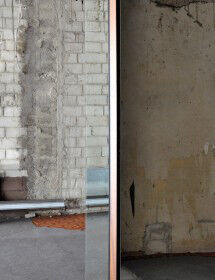
In Tortuga, Beate Mohr employs a documentary-looking visual language that remains deliberately subjective and fragmentary. The photographs do not illustrate a text; instead, they function as autonomous spaces of perception and thought. Meaning emerges through sequencing—via rhythm, repetition, and gaps—rather than through explanation.
The book follows a practice of collecting and ordering without hierarchy. Places, situations, and observations are recorded serially, forming a visual protocol that oscillates between personal archive, travel diary, and conceptual inquiry.