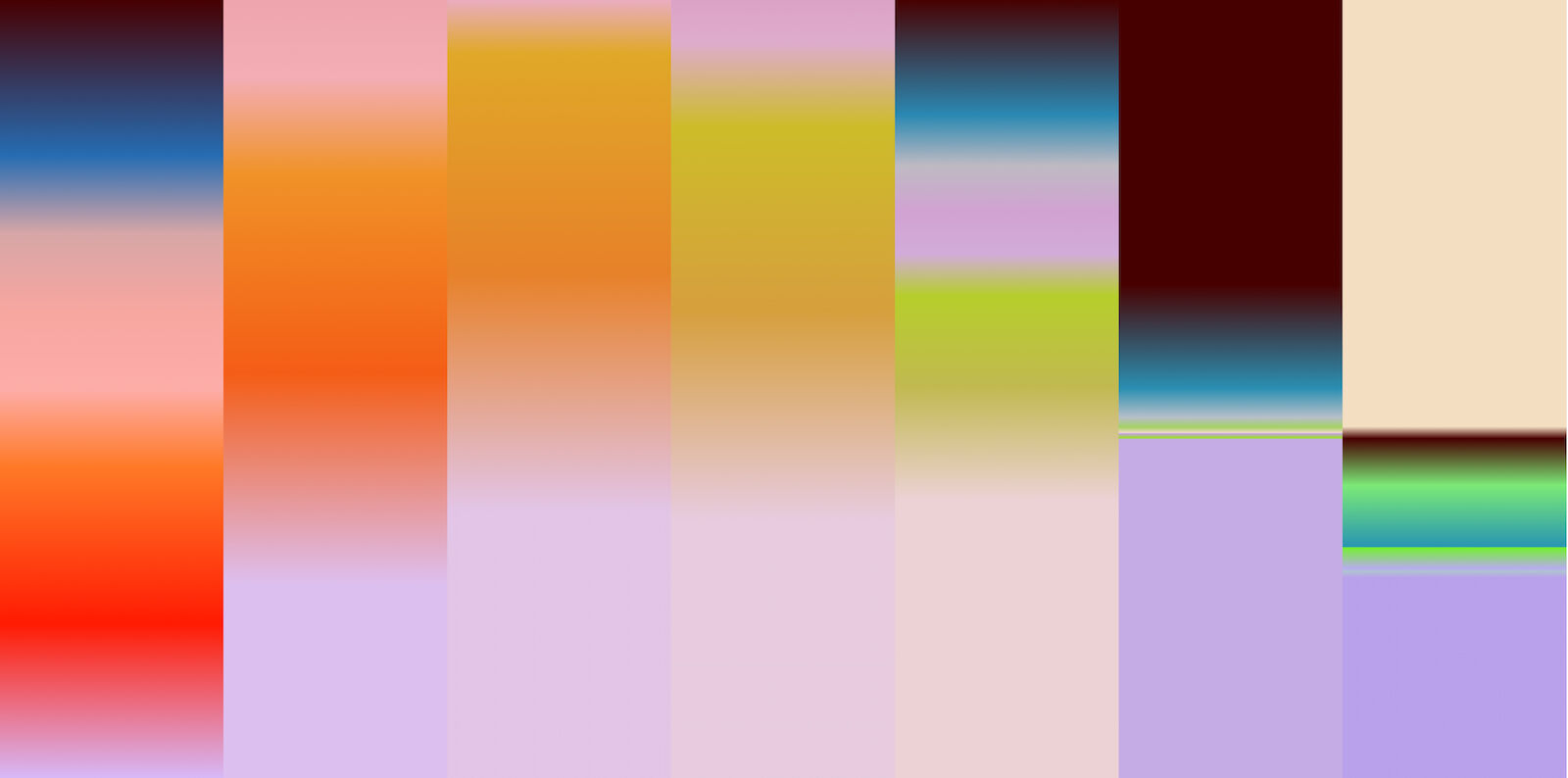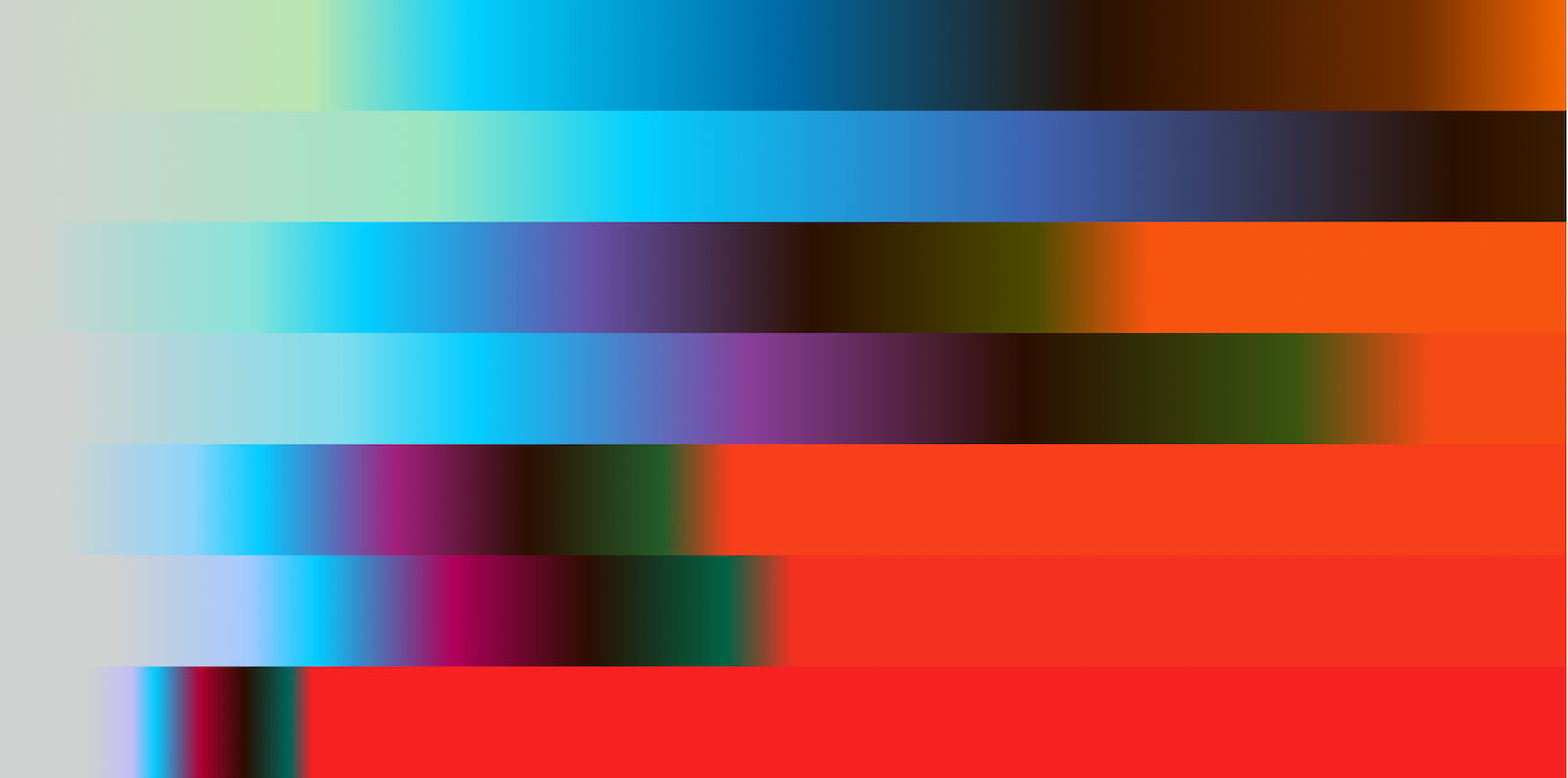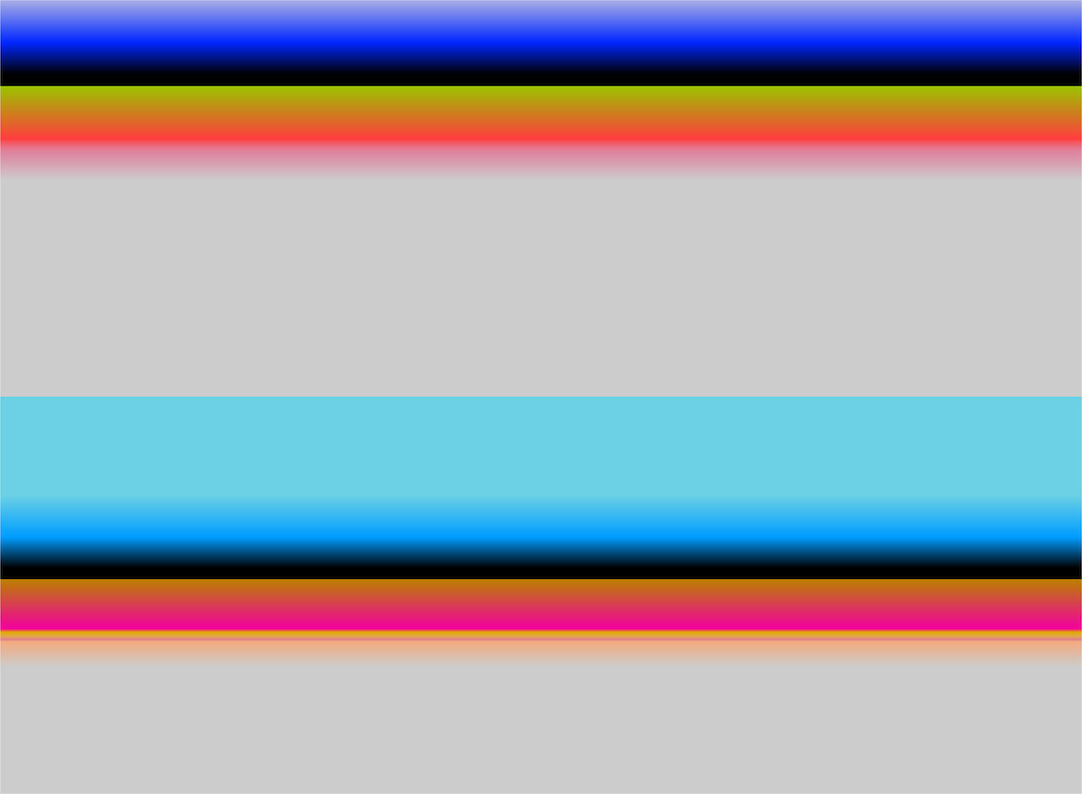
Hard Cover, English, Thread Stitching, 144 Pages
Verloop - Dégradé
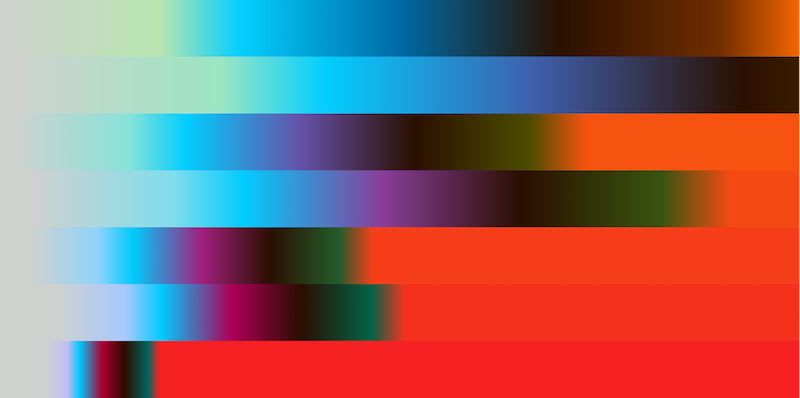
Rare BookThis publication originates from a collaboration with David Aerne, a color scientist and long-term creative partner. Together, we explored generative gradients and examined what happens when color becomes the primary structural parameter of an artwork.
In recent years, I have been increasingly interested in the capacity of computational systems to expand and challenge authorship. What does a machine truly process when it interprets visual information? Where are its limits? Can code generate something autonomous and compelling, or does it inevitably depend on human intention?
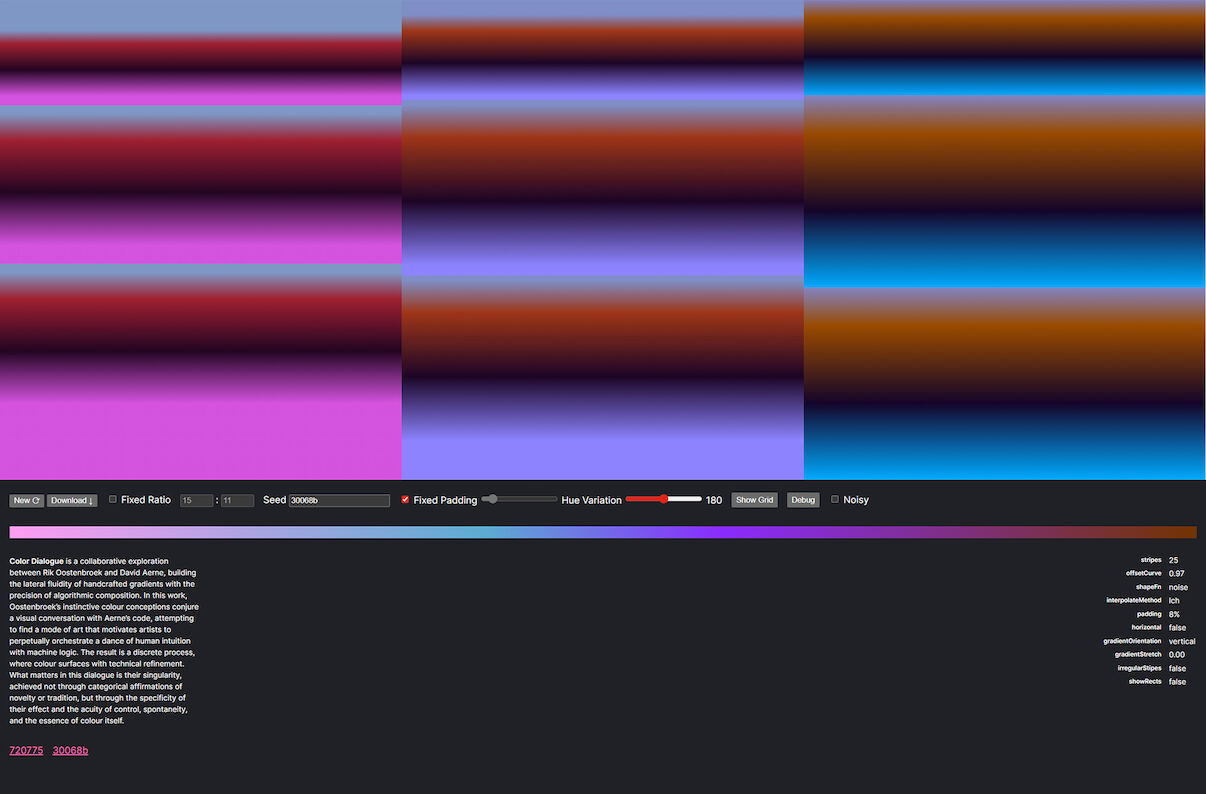
For this project, I shared a substantial archive of my gradients with David and asked him to construct a system capable of producing unexpected results. The premise was simple: if color were treated not as surface but as data, could it operate as the core variable within a generative structure?
My engagement with generative art—works created through algorithmic procedures and defined by finite parameters—led to a central question: What happens when those parameters are reduced to color alone? Would variation remain meaningful, or would repetition ultimately prevail?
The experiment demonstrated the generative potential embedded within chromatic systems. The range of outcomes proved extensive, and the permutations suggested a field of near-infinite variation. What emerges in this book is not a fixed series, but a system—one in which color functions as both material and code.
“Holy cow Rik, you released a book and told no one?” That is more or less what happened. We were so focused on trying to make it to Paris Photo with the book that I completely forgot to announce it. The project originally started as an NFT, where people could own a unique piece of code representing their gradient.
Along the way, we started wondering if it would be possible to bridge those digital pieces into the physical world by turning them into a book. Why not try? The challenges were part of the appeal. Since the artwork was responsive, we had a lot of freedom in how the book could be designed and structured. The idea for the book actually came from Mimi Nguyen of Nguyen Wahed. She simply said, “Hey Rik, let’s do a book.” A book. A real art book.
The goal was to surprise people who had no context for what they were holding. Visually, it looks like a stack of plain A4 printer paper, the kind you load into a printer. I wanted people to feel curious, slightly confused, and unsure of what they were looking at, in a way that would naturally spark conversation. We produced 300 copies and they sold out quickly, even though shipping ended up costing more than the book itself. The book weighs two kilograms. The publication contains no text at all, only images generated entirely through code.
RRose Editions published the book and became an incredible partner throughout the process, helping us understand what worked and what did not. It was a steep learning curve, but a very rewarding one. The content of the book are exactly the pieces that were living on the blockchain.